Reading a Weaving Draft: A Beginner’s Guide to Threading and Treadling Diagrams
October 29, 2026 - Weaving
Put a handwoven inkle band beside a small kilim cushion and you feel the difference before you can name it. The band is thin, dense and firm, with stripes running its length. The cushion is heavier, softer on the surface, and its colour changes across the width. Both may be plain weave. What separates them is which set of threads you can see.
That visible surface is called the face of the cloth. In a weft-faced fabric, the weft covers the warp and creates the surface you see and touch. In a warp-faced fabric, the warp covers the weft and dominates the surface. Neither structure is better than the other. Each is a tool with its own strengths, and the right choice depends on what you want the cloth to do: hold a picture, carry a strap, drape softly, wear well, or show off a particular yarn.
Every cloth is a negotiation between two sets of threads. The warp runs lengthwise under tension; the weft crosses it, over and under. In plain weave each pick passes over one end and under the next. Whether the finished cloth shows warp or weft comes down to proportion: how closely the warp is set, how thick the weft is, and how firmly you beat.
Set the warp ends far apart, beat a thick weft down hard, and the weft swells to fill the gaps. That is weft-faced cloth. Set the ends close, use a fine weft, and beat until the ends touch, and the warp hides the weft: warp-faced cloth. When both show in roughly equal measure you have balanced cloth, which is a third option and often the right one.
The ratio matters more than any single rule. A moderately close sett with a medium weft can drift toward one face or the other depending on how you beat and how much the yarn fulls after washing. This is why sampling is so useful. A few inches woven, cut off and finished will tell you more about the final face than any calculation on paper.
If both sets of threads seem equally present, you are probably looking at balanced cloth. Turn the piece over and compare the two sides. In many balanced weaves the back is a mirror of the front, while in strongly warp-faced or weft-faced cloth the reverse often looks like a different fabric altogether: a hidden scaffold of fine threads instead of the surface you expected.
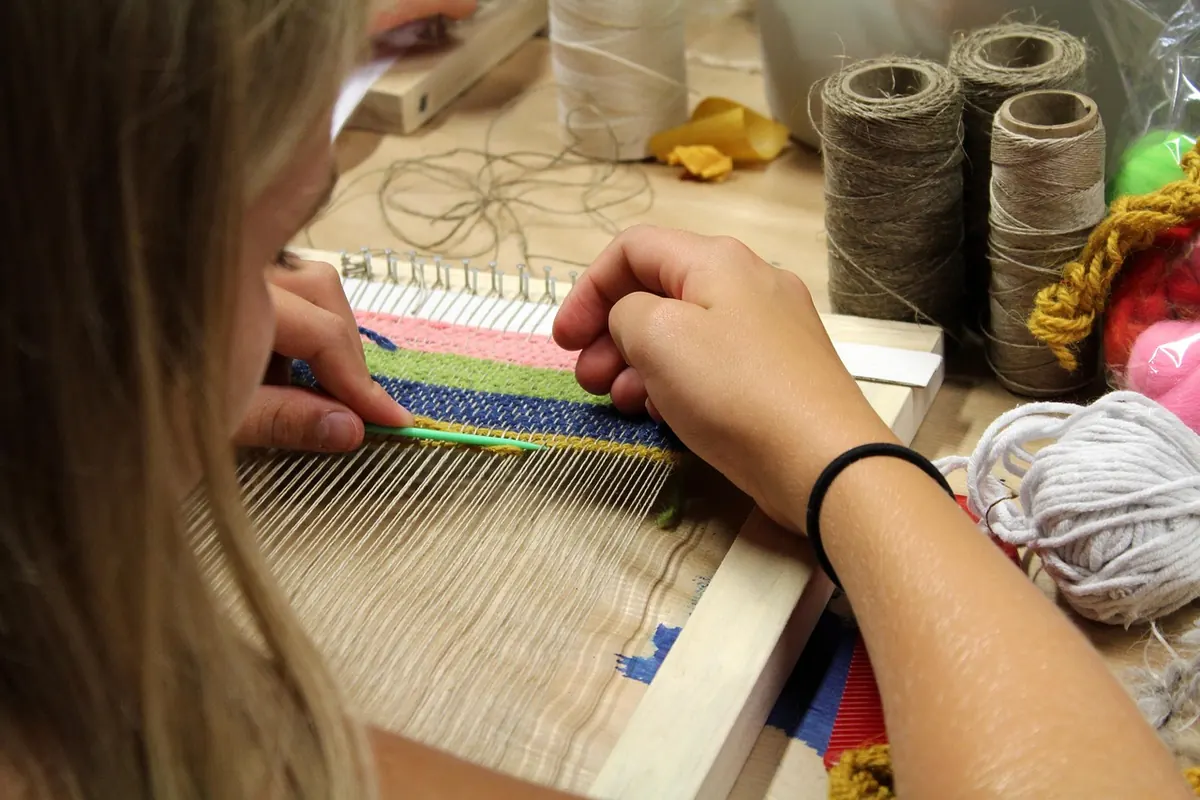
Weft-faced weaving is the choice when the weft is the material you care about. Tapestry, kilim, many rugs, wall hangings, heavy bags and substantial cushion covers belong here. Because the weft sits on the surface, colour changes happen across the width, which is why pictorial work and colour blocks sit so naturally in this structure.
It is also the forgiving direction for yarn. The warp carries the strain of the loom and must be strong and evenly tensioned, but the weft only travels a short distance before it turns, so it can be soft, slubby, handspun, thick-and-thin or fragile. If you have a skein of uneven handspun you want to show off, weave it as weft.
The trade-offs are real. Weft-faced cloth gains weight quickly, eats weft, and draws in at the selvedges as the weft packs down. Frequent colour changes mean a bobbin or butterfly for every colour in play, and those extra packages must be woven in and out or carried up the side, which can create floats or bulk at the selvedge. A temple can help keep the width steady, and careful beating at the edges is often the difference between a clean rug and a scalloped one.
Think of the warp in weft-faced cloth as scaffolding: it must be strong, straight and reliable, but it is not the star of the show.
Finishing deserves planning, too. Weft-faced pieces often need hemstitching, twisted fringe, turned hems or a woven heading to secure the ends. Because the weft is dense, the fabric may not drape much. That is a virtue in a rug or a bag and a drawback in a scarf. If you want softness and drape, weft-faced plain weave is usually not the first door to open.
Warp-faced weaving flips the emphasis. Here the warp ends are set so closely and beaten so firmly that they hide the weft almost completely. The cloth is typically narrow, dense and strong, with patterns running lengthwise. Inkle bands, tablet-woven belts, backstrap-loom sashes, card-woven trim, sturdy straps and many bookmarks are classic warp-faced textiles.
The weft in a warp-faced cloth is often a fine, strong yarn that does its job quietly: it holds the warp ends in order and gives the fabric its crosswise stability. Because the weft is mostly hidden, it is not the place for a precious or highly variegated yarn unless you want occasional flashes at the selvedge. The warp is where colour, pattern and texture live. Lengthwise stripes, checkerboards built from warp colour changes, and intricate card-woven designs all belong naturally to this family.
Warp-faced cloth has its own costs. It uses a great deal of warp yarn, and the warp must be strong enough to withstand high tension and close sett. The cloth is usually firm and low-drape, which is ideal for straps and bands but less so for garments that need to flow. Width is limited by the loom and by the sett, and the weft cannot easily create large pictorial areas across the cloth. If you want an image or a wide colour block, warp-faced weave will fight you.
On the other hand, warp-faced cloth is wonderfully stable. A well-woven inkle band resists stretching, holds its shape and takes abrasion well. It can be used as a handle, a belt, a trim or a seam binding. The density that makes it stiff also makes it durable. When you choose warp-faced weaving, you are choosing structure first and surface second.
Balanced cloth sits between the two extremes. The warp and weft are visible in roughly equal measure, and the fabric tends to be more supple than either a strongly weft-faced rug or a tightly warp-faced band. Tea towels, scarves, shawls, garments and many everyday textiles live here. Balanced plain weave is a good default when you want the yarn itself to show in both directions, when drape matters, or when you want a fabric that behaves predictably on both sides.
Balanced does not mean loose or weak. It means the sett and the weft are matched closely enough that neither set completely covers the other. You can still beat firmly and get a stable cloth. You can still use colour in both directions. The advantage is flexibility: the fabric can be light or medium weight, crisp or soft, depending on the yarn and the finishing.
When you are planning a piece, ask a few practical questions before you wind the warp.
A useful exercise is to weave a short sample of the same yarns at two or three setts. Change the beat as well as the sett. You will quickly see how the face shifts: a looser sett and a heavier weft push the cloth toward weft-facing, while a closer sett and a finer weft push it toward warp-facing. That sample is not wasted time. It is the most reliable guide you have.
The face of a cloth is not decided by the loom alone. It is decided by the conversation between sett, weft size, beat and finishing. A weft-faced piece usually needs a more open warp sett so the weft has room to pack in, plus a weft thick enough to cover the spaces. A warp-faced piece needs a close sett and enough firm beating that the warp ends touch and hide the weft. Balanced cloth needs the two sets to meet in the middle.
Finishing can shift the result. Washing and fulling can swell the weft and make a cloth more weft-faced than it looked on the loom. Pressing can flatten one set of threads and bring the other forward. A piece that seems balanced under tension may change after it is cut down. This is another reason to finish your sample the way you intend to finish the final cloth.
In the end, the difference between weft-faced and warp-faced weaving is a difference in emphasis. One lets the crossing thread speak; the other lets the lengthwise thread carry the tune. Knowing which one you are weaving, and why, makes every decision easier: the yarn you choose, the sett you wind, the beat you use and the finish you plan. The cloth will still surprise you at the loom, but it will surprise you in the right direction.
Photo: virin000 / Pixabay
A weaving draft is four connected diagrams, not a code. Here is how threading, tie-up, treadling and drawdown...
A practical comparison of twisted fringe, hemming and wet-finishing for handwoven scarves, judged on time,...
Copyright © 2026 Telaio Sottovoce. All Right Reserved.