Reading a Weaving Draft: A Beginner’s Guide to Threading and Treadling Diagrams
October 29, 2026 - Weaving
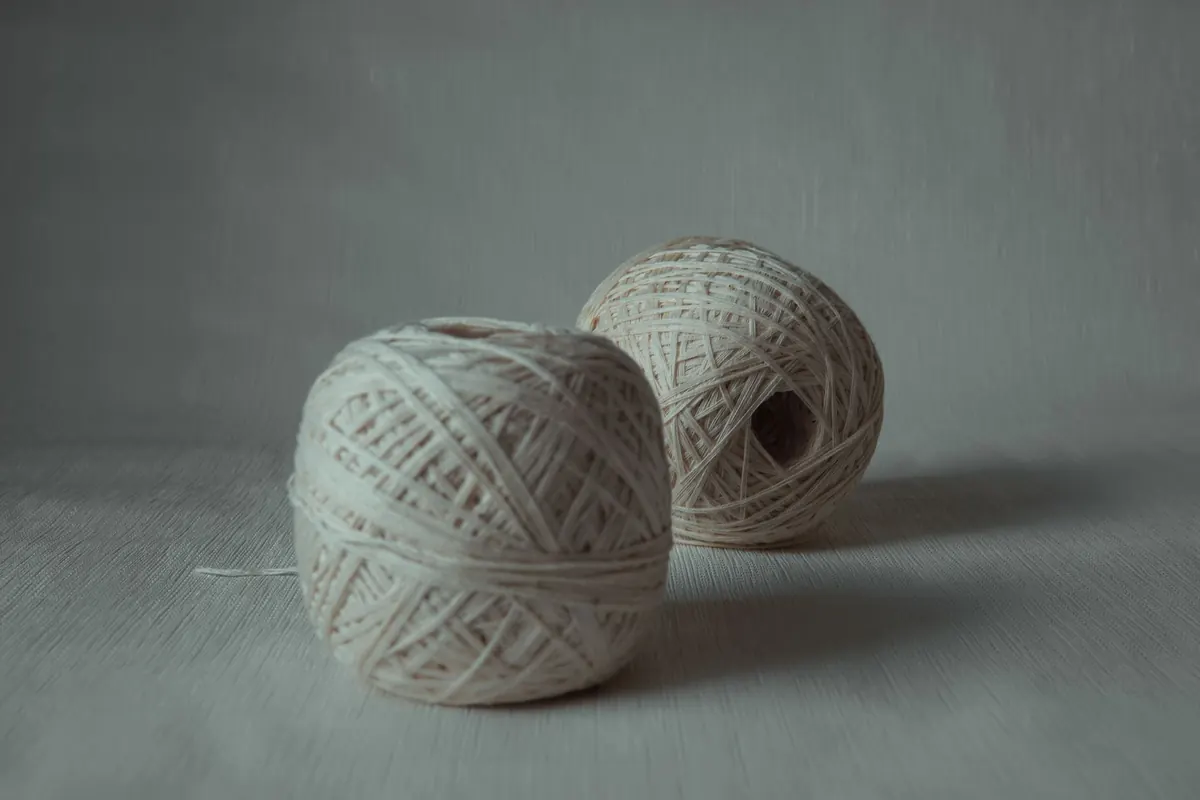
A warp end that breaks at the back beam, three hours into a project, teaches you more about yarn than any swatch card. Weft travels a short and forgiving path; warp yarn spends the whole length of the cloth pulled taut, sliding through heddle eyes and reed dents thousands of times. Linen and cotton are the two workhorses on most handweavers' shelves, and they behave nothing alike under that kind of pressure. The question is not which one is better. It is which one suits the cloth you have in mind, and how much attention you are willing to give it at the loom.
Before comparing fibers, it helps to be clear about the job. A warp yarn has to hold tension without stretching out of shape, survive abrasion from the reed, stay roughly even in diameter so the cloth doesn't show streaks, and behave predictably when it finally gets wet. A yarn can be beautiful as weft and hopeless as warp — a soft, slubby singles being the classic example.
Two properties do most of the work: elasticity and abrasion resistance. They pull in opposite directions more often than you'd expect, and linen and cotton sit at nearly opposite ends of the scale on both.
Linen has very little stretch and even less elastic recovery. Pull a linen end and it resists, then stays where you put it. That stubbornness is why linen cloth keeps its shape, presses to a crisp fold, and looks a little architectural on the table. It is also why linen is unforgiving at the loom. Uneven tension shows up immediately as slack ends, bouncing shafts, or a warp that seems to fight the beater.
Beam linen firmly and evenly, advance it in small increments, and it rewards you with clean sheds and steady selvedges. Treat it casually — soft tension, long advances, a rough lashing-on — and you will spend the afternoon knotting.
Cotton is the opposite temperament. It stretches under tension and recovers much of that stretch when the tension eases. That give absorbs small mistakes: a slightly loose end, a heddle that isn't quite aligned, a warp beam wound by hand with uneven layers. For newer weavers, or for long warps that will sit on the loom for weeks, cotton's forgiveness is worth a great deal.
The trade-off appears after the cloth comes off. Cotton that has been held under tension can relax and sag over time, and a cotton warp will draw in more than you expect as you weave. Linen holds the tension you gave it. If you want a warp you can leave and return to without re-tensioning, linen is the calmer companion.
Linen is a strong fiber, stronger wet than dry, and its long staple means a well-spun line linen resists abrasion beautifully. Cloth made from it outlasts most things in the cupboard. The catch is that linen doesn't fail gradually. It has poor flex life, so it tends to snap rather than stretch, and it snaps at the worst places: a tight knot, a sharp bend around a metal heddle, a spot where the yarn has been dragged across a burr.
Cotton has good flex life and takes repeated bending well, but it is softer and more prone to fuzzing and pilling where the reed rubs. Look along the reed after a few inches of weaving: a fuzzy white line means abrasion is winning.
Yarn structure matters as much as fiber. For warp, choose line linen rather than tow — tow is fine for weft but fuzzy and weak for the tension of a warp. In cotton, a smooth, firmly twisted combed or ring-spun yarn will serve far better than a soft singles or a slub yarn. Save the textured, slubbed, and softly spun yarns for weft, where their irregularities become the point rather than a problem.
Both fibers shrink, and both take up during weaving, but they do it differently. Linen is dimensionally stable once it has been properly wet-finished; most of its movement happens in the first wash and in the hard press that follows, and after that the cloth settles down. Cotton can keep shrinking over several washes, and its elasticity means the cloth relaxes and creeps after it leaves the loom.
Do not guess at these numbers. Weave a sample, cut it off, finish it exactly as you plan to finish the finished cloth, and measure it dry. That sample is the only honest estimator you have, and it takes less time than re-weaving a too-short runner.
A few practical habits help with both fibers:
A rough guide, based on how each fiber behaves rather than on rules:
There is also the middle path. A cotton warp with a linen weft gives you an easy-to-weave ground and linen's dry texture on the surface. A linen warp with a cotton weft makes a towel that dries quickly and feels substantial. Blended warp yarns, spun from both fibers, are common for good reason — they borrow a little elasticity from the cotton and a little strength from the linen.
If you are torn, weave two small warps — say thirty or forty centimetres wide and a metre and a half long — with the same sett proportion and the same weft, one in linen and one in cotton. Finish both the way you intend to finish the real cloth, then handle them. Fold them, hang them, wash them again. Keep a note of the yarn, the sett, and the finished dimensions pinned to each sample.
That pair of samples will tell you more about your own taste than any comparison chart, and it costs you an afternoon. Linen will teach you to beam carefully and to trust a firm tension. Cotton will forgive you while you learn. Most of us end up keeping both on the shelf, and reaching for whichever one the cloth is asking for.
Photo: Dmitry Demidov / Pexels

A weaving draft is four connected diagrams, not a code. Here is how threading, tie-up, treadling and drawdown...
A practical comparison of twisted fringe, hemming and wet-finishing for handwoven scarves, judged on time,...
Copyright © 2026 Telaio Sottovoce. All Right Reserved.